

Sujet : Développement et caractérisation physico-chimique et biologique de nanoassemblages théranostiques pour une application en cancérologie
Résumé du projet : Le développement de systèmes capables d’améliorer l’efficacité des traitements tout en limitant leurs effets indésirables constitue un enjeu majeur en recherche biomédicale. Parmi les stratégies envisageables, la synthèse de nanoplateformes capables de vectoriser des agents thérapeutiques tout en véhiculant d’autres fonctions complémentaires est une approche des plus pertinentes.
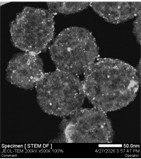
C’est dans ce cadre que nous proposons un stage de recherche en Master 2. Ce stage s’intègre au projet i-NanoT, financé par les Fonds européens de développement régional (FEDER). Il rassemble plusieurs partenaires universitaires, cliniciens, biologistes et industriels de la région Bourgogne-Franche-Comté. L’objectif est de proposer des solutions innovantes à base de nanomatériaux pour des applications en oncologie ainsi que dans le traitement des pathologies infectieuses et inflammatoires. Dans le cadre des traitements en oncologie, un des projets est de développer des nanoassemblages théranostiques associant des nanoparticules de silice mésoporeuses (MSNs) et des nanoparticules d’or (AuNPs). Les MSNs constituent des nanovecteurs présentant une structure poreuse permettant l’encapsulation d’agents thérapeutiques. Les AuNPs apportent des propriétés radiosensibilisantes et peuvent également être fonctionnalisées par des ligands permettant la complexation d’agents d’imagerie pour des applications diagnostiques. L’association de ces deux nanoobjets vise ainsi à développer une plateforme combinant des fonctions de vectorisation d’agents thérapeutiques, de radiosensibilisation et d’imagerie, dans une approche théranostique.
Missions : La personne recrutée participera au développement, à l’optimisation et à l’évaluation physico-chimique et biologique des nanoassemblages à travers différentes missions :
- Optimisation de la synthèse des MSNs pour une application en oncologie.
- Optimisation du greffage des AuNPs en surface des MSNs et étude de leur stabilité colloïdale.
- Développement et caractérisation de la fonction d’imagerie.
- Etude de l’encapsulation d’un agent anticancéreux dans les MSNs.
- Évaluation in vitro des nanoassemblages sur différentes lignées tumorales.
Techniques mises en œuvre au cours du projet : Méthodes de synthèse et de fonctionnalisation de nanoparticules, techniques de caractérisation physico-chimique (DLS, MET, ICP-AES, …), et biologique (tests de cytotoxicité, cytométrie en flux…).
Profil recherché : La personne recrutée (H/F) devra être en Master 2 dans le domaine de la chimie générale, chimie des matériaux, nanosciences, biochimie ou biotechnologies et avoir de l’expérience pratique en laboratoire (travaux pratiques et stages expérimentaux). Des connaissances en biologie cellulaire et un intérêt pour les applications biomédicales seraient appréciées. La personne recrutée devra faire preuve de curiosité scientifique, d’autonomie et d’aptitude à travailler dans un environnement interdisciplinaire.
Environnement de travail : Le stage sera réalisé sous la supervision du Dr Frédéric Bouyer et de Mahaut de Berranger, au sein du Laboratoire ICB (UMR 6303 CNRS/UBE, Dijon, France), dans le cadre du projet i-NanoT et en collaboration avec le CTM (UMR 1231 INSERM/UBE, Dijon, France) ainsi que d’autres partenaires du projet i-NanoT.
Références :
M. de Berranger et al., International Conference on Nanomedicine, Cancer Therapy, Safety Assessment & Sustainability, Strasbourg, France, 2026.
i-NanoT, Projet de structuration de la filière nanomédecine en Bourgogne-Franche-Comté, 2026. https://i-nanot.fr/
E. Hernando Abad et al., Int. J. Pharm., 687, 2026, 126395.
M. Varache et al., J. Nanopart. Res., 17(9), 2015, 356.
Personnes à contacter :
Dr Frédéric Bouyer : Frederic.Bouyer@u-bourgogne.fr
Mahaut de Berranger : Mahaut.de-Berranger@u-bourgogne.fr
English version below :
Title: Development and Physicochemical and Biological Characterization of Theranostic Nanoassemblies for Cancer Applications
Project Overview: The development of systems capable of improving the efficacy of treatments while limiting their adverse effects represents a major challenge in biomedical research. Among the strategies being investigated, the development of nanoparticle-based platforms capable of delivering therapeutic agents while incorporating additional complementary functions is a particularly promising approach.
Within this context, we offer a research internship for a second-year Master’s student. This internship is part of the i-NanoT project, funded by the European Regional Development Fund (FEDER). The project brings together academic, clinical, biological, and industrial partners from the Bourgogne-Franche-Comté region. Its objective is to develop innovative nanomaterial-based solutions for applications in oncology, as well as for the treatment of infectious and inflammatory diseases. In the field of oncology, one of the research projects focuses on the development of theranostic nanoassemblies combining mesoporous silica nanoparticles (MSNs) and gold nanoparticles (AuNPs). MSNs are nanocarriers with a porous structure that enables the encapsulation of therapeutic agents. AuNPs provide radiosensitizing properties and can also be functionalized with ligands capable of complexing imaging agents for diagnostic applications. Combining these two nanomaterials aims to develop a multifunctional platform integrating therapeutic agent delivery, radiosensitization, and imaging capabilities within a theranostic approach.
Research Activities: The recruited student will participate in the development, optimization, and physicochemical and biological evaluation of the nanoassemblies through the following activities:
- Optimization of MSNs synthesis for oncology applications.
- Optimization of AuNPs grafting onto the MSNs surface and investigation of colloidal stability.
- Development and characterization of the imaging function.
- Investigation of the encapsulation of an anticancer agent within MSNs.
- In vitro evaluation of the nanoassemblies using different tumor cell lines.
Experimental Techniques: Methods for the synthesis and functionalization of nanoparticles; techniques for physicochemical characterization (DLS, TEM, ICP-AES, etc.) and biological characterization (cytotoxicity assays, flow cytometry, etc.).Candidate Profile: The candidate should be enrolled in a second-year Master’s degree in general chemistry, materials chemistry, nanoscience, biochemistry, biotechnology, or a related field, and should have practical laboratory experience through experimental coursework and research internships. Knowledge of cell biology and an interest in biomedical applications would be appreciated. The candidate should demonstrate scientific curiosity, autonomy, and the ability to work in an interdisciplinary research environment.
Research Environment: The internship will be carried out under the supervision of Dr. Frédéric Bouyer and Mahaut de Berranger at the ICB Laboratory (UMR 6303 CNRS/UBE, Dijon, France), as part of the i-NanoT project. The work will be conducted in collaboration with the CTM Laboratory (UMR 1231 INSERM/UBE, Dijon, France) and other partners involved in the i-NanoT project.
References :
M. de Berranger et al., International Conference on Nanomedicine, Cancer Therapy, Safety Assessment & Sustainability, Strasbourg, France, 2026.
i-NanoT, Project to develop the nanomedicine sector in Bourgogne-Franche-Comté, 2026. https://i-nanot.fr/
E. Hernando Abad et al., Int. J. Pharm., 687, 2026, 126395.
M. Varache et al., J. Nanopart. Res., 17(9), 2015, 356.
Contacts :
Dr. Frédéric Bouyer : Frederic.Bouyer@u-bourgogne.fr
Mahaut de Berranger : Mahaut.de-Berranger@u-bourgogne.fr
